The five objects of governance
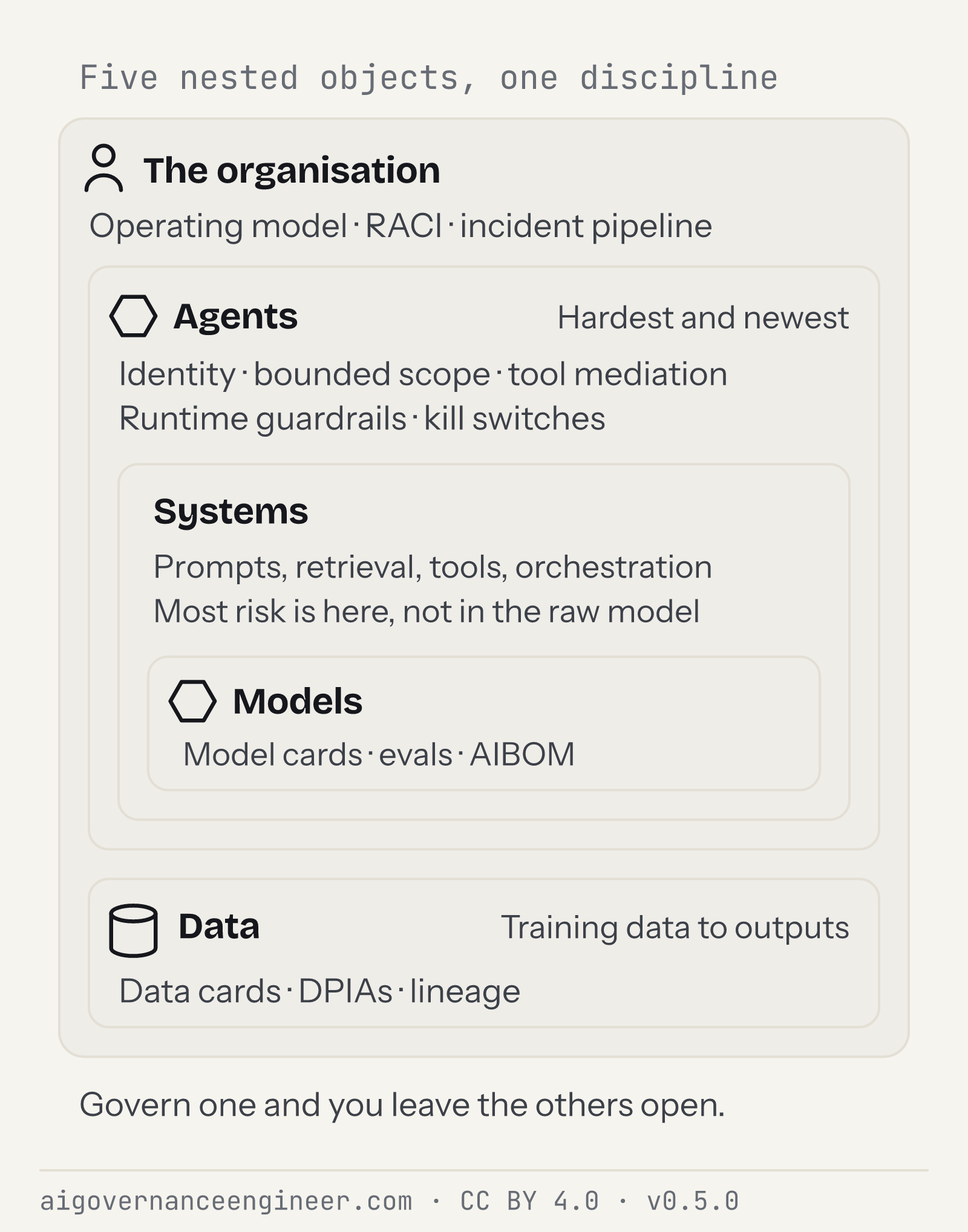
Five nested objects: models inside systems inside agents, with data beside them, all inside the organisation, each with the controls that govern it.
Text alternative
Five nested objects, each needing different controls. Models: the trained artefacts (foundation models, fine-tunes, classifiers), governed with model cards, evals and AIBOM. Systems: the application around the model (prompts, retrieval, tools, orchestration, the human and machine users); most risk is here, not in the raw model. Agents: systems that act, governed with identity, bounded scope, tool mediation, runtime guardrails and kill switches; the hardest and newest object. Data: training data, retrieval corpora, prompts and outputs, governed with data cards, DPIAs and lineage. The organisation: the roles, decision rights, escalation paths and accountability around all of the above, governed with an operating model, RACI and an incident pipeline. The discipline is coherent only when it addresses all five.
Download
Every file carries the attribution band "aigovernanceengineer.com · CC BY 4.0 · v0.5.0" inside the image, and the version is in the file name, so a copy always says where it came from and which edition it shows. The SVGs keep the text live: the first follows the viewer's light or dark setting, the other two fix one theme for slides and print. The PNGs are drawn with the site's own typefaces.
Reuse and credit
The figure is published under CC BY 4.0: you may copy, share and adapt it, commercially too, provided you give appropriate credit, link to the licence and say if you changed it. Keep the attribution band in the image. A credit line that covers title, author, source and licence:
“The five objects of governance” by Jorge García Aibar, aigovernanceengineer.com (https://aigovernanceengineer.com/figures/five-objects), v0.5.0. Licensed under CC BY 4.0 (https://creativecommons.org/licenses/by/4.0/).
Embed with HTML
<figure>
  <img src="https://aigovernanceengineer.com/downloads/figures/five-objects-v0.5.0-light-1600.png" alt="Five nested objects: models inside systems inside agents, with data beside them, all inside the organisation, each with the controls that govern it." width="800" height="1019" loading="lazy">
  <figcaption>
    <a href="https://aigovernanceengineer.com/figures/five-objects">The five objects of governance</a> by Jorge García Aibar,
    aigovernanceengineer.com, v0.5.0.
    Licensed under <a href="https://creativecommons.org/licenses/by/4.0/">CC BY 4.0</a>.
  </figcaption>
</figure>Embed with Markdown

*[The five objects of governance](https://aigovernanceengineer.com/figures/five-objects) by Jorge García Aibar, aigovernanceengineer.com, v0.5.0. Licensed under [CC BY 4.0](https://creativecommons.org/licenses/by/4.0/).*